The 1% savings rule, revisited with real math
A small savings-rate increase is not magic. It is a repeatable claim on future income—and time does most of the visible work.
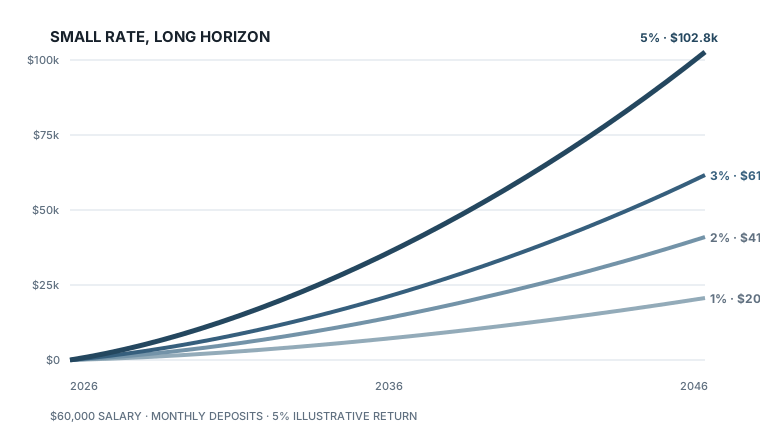
Increasing savings by one percentage point can produce real money: $600 a year on a $60,000 salary grows to about $20,552 over 20 years at 5%. The useful rule is not “save 1%.” It is “raise your rate by 1% now, then repeat when cash flow allows.” Compounding rewards the sequence, not the slogan.
In January 2026, a reader earning $60,000 and saving 6% would put away $3,600 a year. Moving to 7% adds only $50 per month. That amount can feel too small beside a six-figure retirement target. The arithmetic says otherwise: consistency turns a modest payroll decision into a five-figure balance without requiring a dramatic austerity month.
What one percentage point actually buys
Our base case assumes gross pay of $60,000, monthly contributions, a 5% nominal annual return compounded monthly, and a flat salary. It ignores taxes, fees, employer matches, and inflation so the effect of the savings rate stays visible. The future-value formula is contribution × [((1 + monthly return) to the number of months − 1) ÷ monthly return].
One percent equals $600 per year, or $50 per month. After five years, deposits total $3,000 and the modeled balance is $3,400. At ten years, $6,000 of deposits becomes $7,764. At twenty years, $12,000 becomes $20,552. Investment growth contributes $8,552—substantial, but only because the deposits kept arriving.
| Rate added | Monthly amount | 5 years | 10 years | 20 years |
|---|---|---|---|---|
| 1% | $50 | $3,400 | $7,764 | $20,552 |
| 2% | $100 | $6,801 | $15,528 | $41,103 |
| 3% | $150 | $10,201 | $23,292 | $61,655 |
| 5% | $250 | $17,002 | $38,821 | $102,758 |
Compounding is not the first engine
The chart’s curve can make return look like the hero. For the first decade, behavior matters more. In the 1% case, deposits account for $6,000 of the $7,764 balance at year ten. A person waiting for a perfect investment while contributing nothing has no base to compound. The rate increase is valuable because it moves money before ordinary spending absorbs it.
This is also why high-yield claims need restraint. At 7% instead of 5%, the 20-year 1% balance would be about $26,046; at 3%, about $16,415. Returns change the ending, but none is guaranteed. A controllable contribution rate is a stronger planning input than an optimistic market assumption.
A practical staircase, not a purity test
Suppose the saver raises the rate by one point every January for five years, beginning January 2026. The extra monthly deposits become $50, then $100, $150, $200, and $250. If that fifth-year rate continues, the added stream is worth roughly $88,300 by the end of 2045 at 5%. The exact result depends on deposit timing, but the design is clear: small decisions can form a large permanent gap between income and spending.
Annual increases work especially well when paired with raises. If take-home pay rises by $120 a month, routing $50 to savings still leaves $70 of visible improvement. That avoids the false choice between enjoying every raise and saving all of it. Our budgeting-app selection guide recommends testing whether percentage transfers and goals are easy to adjust before paying for software.
When the rule should wait
A rate target should not create an overdraft. If rent, food, utilities, minimum debt payments, or a small cash buffer are unstable, solve the timing problem first. A 1% retirement increase can be sensible while paying expensive debt when it captures a full employer match; without a match, a credit card charging 24% is mathematically more urgent than an account modeled at 5%.
The base percentage also matters. Moving from 0% to 1% establishes a system, but it does not make retirement adequately funded. Moving from 14% to 15% may complete a reasonable long-term target. The rule is a direction and cadence, not a verdict about sufficiency. Use the plain-English glossary for the difference between APY, cash flow, and sinking funds.
The cost of waiting one year
If the $50 monthly increase starts in January 2027 rather than January 2026 and both plans end in December 2045, the delayed version has about $1,574 less at 5%. Only $600 is the missed first-year contribution; the remainder is growth that first cohort never gets to earn. Delay is expensive precisely because an early contribution has more months.
On August 3, 2026, the honest conclusion is deliberately modest. One percent will not rescue an impossible budget or guarantee wealth. It can, however, convert an intention into an automatic, measurable rate. Raise it, observe one full pay cycle, and repeat only when the cash-flow evidence says the change is durable. For automation tradeoffs, see our 60-day rule audit.
Frequently asked questions
How much is 1% of a $60,000 salary?
It is $600 per year, $50 per month, or about $23.08 per biweekly paycheck before rounding.
Does the 1% rule guarantee a 5% return?
No. Five percent is an illustration, not a forecast. Actual returns, taxes, fees, and inflation can raise or lower the result.
Should I save 1% while carrying credit-card debt?
Prioritize required bills and minimums. Capture an employer match when available, but debt near 20% or more usually outranks unmatched investing modeled at 5%.