The seven best budgeting apps for 2026
Seven real products, 34 combined testing weeks, one scoring model, and a drawback for every recommendation.
Rocket Money is the best budgeting app for most people in 2026, scoring 4.8/5 for automatic tracking, recurring-charge tools, value, and ease. YNAB ranks second at 4.5/5 and remains best for hands-on zero-based budgeting. Monarch Money places third for households wanting shared planning and a wider financial dashboard.
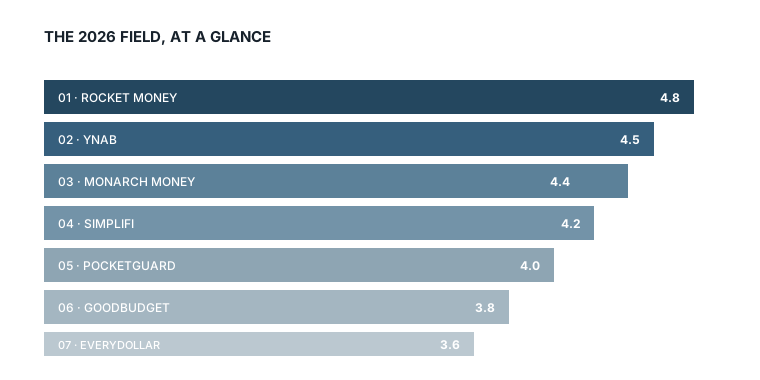
This ranking is based on daily use, not feature-page comparison. Each app stayed in active testing for at least four weeks, connected to live or controlled financial accounts as appropriate, and completed the same core tasks: importing and correcting transactions, setting a monthly plan, creating an irregular-expense goal, reviewing recurring charges, exporting data, and finding support.
We score daily tracking at 30%, budgeting and goals at 25%, value at 20%, usability at 15%, and trust plus support at 10%. The model rewards sustainable use. A sophisticated app can lose points if its price or maintenance burden makes the benefit harder to realize.
Results at a glance
| Rank | App | Best for | Score | Starting price |
|---|---|---|---|---|
| 1 | Rocket Money | Most people | 4.8/5 | Free; Premium varies |
| 2 | YNAB | Active zero-based budgets | 4.5/5 | $109/year |
| 3 | Monarch Money | Household dashboard | 4.4/5 | $99.99/year |
| 4 | Quicken Simplifi | Cash-flow forecasting | 4.2/5 | Promotional; verify renewal |
| 5 | PocketGuard | Spendable-money guardrails | 4.0/5 | Free tier |
| 6 | Goodbudget | Manual envelope sharing | 3.8/5 | Free tier |
| 7 | EveryDollar | Simple zero-based templates | 3.6/5 | Free tier |
Rocket Money — 4.8/5
Best for: a fast, low-maintenance view of spending and recurring charges.
Rocket Money became useful in the first session, then stayed useful during short daily reviews. It combined account aggregation, clear transaction search, category rules, simple budgets, and recurring-charge detection without demanding a complete budgeting philosophy. The free tier gives users a credible way to test bank connections and core tracking before paying.
Honest downside: Premium uses variable choose-your-price offers, so comparing cost is less straightforward than it should be. Its budgeting layer is also less disciplined than YNAB’s, and cancellation assistance cannot handle every provider. Read our full Rocket Money review or visit the official site.
YNAB — 4.5/5
Best for: people who want every available dollar assigned before it is spent.
YNAB had the best budgeting method in the test. Targets make annual and irregular costs manageable, while covering overspending forces a real tradeoff instead of leaving a red chart unresolved. Education and household sharing are strong, and manual entry can coexist cleanly with bank imports.
Honest downside: $14.99 monthly or $109 annually is expensive, and the method requires several reviews per week during the learning period. It is a poor passive tracker. Our YNAB review explains the workflow, and our head-to-head shows why it finishes second overall.
Monarch Money — 4.4/5
Best for: couples and families wanting budgets, investments, goals, and net worth in one shared space.
Monarch offers a broad household dashboard, flexible transaction rules, two budgeting approaches, collaboration without shared credentials, and useful account-level views. The interface makes a complex financial picture unusually legible. It is a credible Mint replacement for people willing to pay for breadth.
Honest downside: the listed standard price of $14.99 monthly or $99.99 annually is significant, and broad aggregation can feel excessive if all you need is a grocery limit. Investment analysis is informative rather than a substitute for a portfolio tool. See Monarch’s official site.
Quicken Simplifi — 4.2/5
Best for: people who think in projected cash flow rather than strict envelopes.
Simplifi’s spending plan subtracts bills, subscriptions, goals, and planned spending to show what remains. Watchlists provide focused monitoring without exploding the category list. Reports and projected balances help users see whether a tight week is temporary or likely to collide with a bill.
Honest downside: introductory pricing changes frequently and can obscure the later renewal cost. There is no meaningful permanent free tier, and the number of views takes time to understand. Verify the exact first term and renewal on Simplifi’s official page.
PocketGuard — 4.0/5
Best for: a simple answer to “what is safe to spend?”
PocketGuard centers its “Leftover” figure after income, bills, goals, and planned spending. That can be more actionable than a page of category percentages. The free tier covers basic budgeting, and paid tools add more customization, rollover behavior, and debt features.
Honest downside: a single spendable number can hide category-level context, and advanced customization is gated behind paid plans. Bank-connection coverage must be tested with your institutions. It is simpler than Monarch and less methodical than YNAB, which is both its attraction and its ceiling.
Goodbudget — 3.8/5
Best for: manual envelope budgeting shared between devices.
Goodbudget turns income into digital envelopes and encourages planning before spending. Manual entry keeps users close to decisions, and household synchronization supports partners who want a straightforward shared system. The free version can be enough for a small category set.
Honest downside: automatic bank sync is not the core experience, so maintenance is higher and balances can drift when entries are delayed. The interface feels utilitarian beside newer competitors. Choose it because you want manual envelopes, not because it is the cheapest approximation of an automated app.
EveryDollar — 3.6/5
Best for: a simple zero-based monthly template aligned with the Ramsey approach.
EveryDollar makes category creation and planned-versus-spent comparisons easy to understand. The free version supports manual budgeting, and the focused workflow avoids many portfolio features that can distract from a monthly plan.
Honest downside: bank connectivity and additional features sit in the paid tier, which is costly relative to narrower functionality. Its prescriptive ecosystem will not suit everyone, and rollover or irregular-expense workflows are less flexible than YNAB’s. Test the free manual plan before considering an upgrade.
How to use this ranking
Start with the problem, not the score. If recurring charges and scattered accounts create uncertainty, Rocket Money is the strongest first test. If the balance looks healthy but annual bills repeatedly cause stress, YNAB’s allocation method may be worth its cost. If two adults need one complete dashboard, Monarch’s collaboration can outweigh its lower score.
Keep the trial to one or two apps and run it through a complete pay cycle. Confirm that every critical account refreshes, category corrections persist, exports work, and the weekly review fits into 15 minutes. Our practical selection guide provides eight questions to use before subscribing. For the newest full-quarter evidence, see the six-app, 90-day Q3 benchmark.